In Florida, the air conditioner is not a convenience — it is survival equipment. When a system dies in July, the homeowner does not open the phone book or scroll to page two of Google. They type “AC repair near me,” tap one of the first three businesses on the map, and call. Whoever owns those three spots owns the emergency-call economy in that city.
That cluster of three listings is the Google Map Pack, and for an HVAC company it is the single most valuable piece of digital real estate that exists. This guide walks through exactly how Florida HVAC contractors earn a spot in it, what changed recently that quietly broke a lot of old advice, and the specific moves that turn a Google Business Profile into a steady source of booked jobs.
Why the Map Pack decides who eats in HVAC
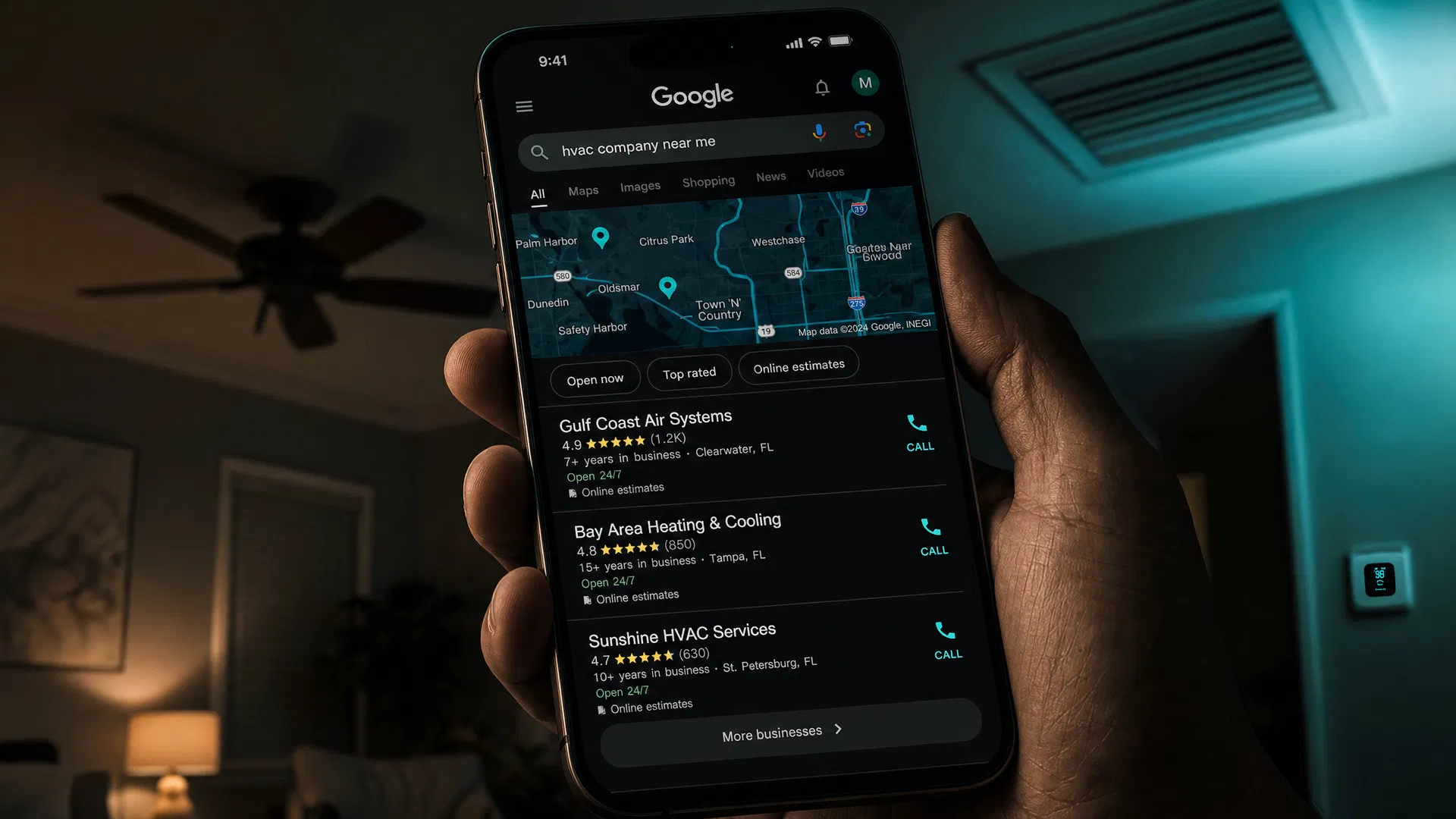
Most HVAC searches carry urgent, local, high-dollar intent. Someone searching “emergency AC repair Cape Coral” at 9 p.m. in August is not comparison shopping for a week — they are calling the first credible business they see. Google knows this, which is why for local-service queries it pushes the Map Pack above the regular blue links. The businesses ranked there capture the overwhelming majority of clicks and calls before an organic result is ever seen.
For a Florida HVAC company, three things make this especially lucrative: demand runs year-round instead of seasonally, individual jobs are worth hundreds to many thousands of dollars, and customer intent is immediate. A profile that ranks well isn’t a vanity metric — it’s a pipeline.
What recently changed (and why old GBP advice is now wrong)
Google has trimmed several Business Profile features that contractors used to lean on. If you read a guide written before 2024, assume parts of it are stale. The important changes for HVAC owners:
- Chat and messaging are gone. Google retired the in-profile messaging and chat feature, along with the chat-based FAQ and the ability for customers to request a quote through the profile. If your lead strategy depended on customers messaging you through Google, that channel no longer exists. Replace it with a prominent click-to-call setup and a fast website contact form.
- Call history was removed. Google no longer tracks the calls that originated from your listing inside the profile. To actually measure which calls come from Google, you need a dedicated tracking number through a service like CallRail. Without it, you are guessing at your real return.
- The free GBP website builder was discontinued. Google shut down the bare-bones website it used to spin up from your profile. Any HVAC business still relying on that “free” site now has a dead link where a lead-capture page should be — which is exactly why a real, fast website is no longer optional.
None of these break the core value of the profile. They just change where the leads land. The profile gets you found; your phone and your website close the loop.
How Google actually ranks local results
Google ranks the Map Pack on three factors, and every optimization below maps to one of them:
- Relevance — how well your profile matches what the searcher wants. Driven by your categories, services, and the words in your reviews and description.
- Distance — how close you are to the searcher. You can’t move your shop, but you can define your service area correctly so you appear across the cities you actually cover.
- Prominence — how well-known and trusted Google thinks you are. Driven by review volume and recency, citations, links, and overall activity.
You can’t beat physics on distance, but relevance and prominence are entirely within your control. Here’s how to maximize both.
The Florida HVAC GBP playbook
1. Get your categories exactly right
Your primary category is the strongest relevance signal you have. For most full-service HVAC companies, that’s “HVAC Contractor.” Then stack secondary categories that match the services you actually offer — “Air Conditioning Repair Service,” “Air Conditioning Contractor,” “Furnace Repair Service,” “Heating Contractor.” Don’t add categories for work you don’t do; irrelevant categories dilute the profile and can suppress the ones that matter.
2. Define your service area like a Florida operator
If you run your business from a shop and travel to customers, set up a service-area business and list the specific cities and counties you cover — Fort Myers, Cape Coral, Naples, Bonita Springs, Port Charlotte, and out toward the metros you genuinely serve. Be honest: padding your service area with cities you’ll never drive to weakens your relevance everywhere. Tight, accurate coverage beats a wide, thin one.
3. Fill out every single field
Google rewards completeness, and most competitors leave fields blank. Complete the full services list with descriptions, set accurate hours (and special hours for holidays), add your service options, and write a business description that naturally mentions your core services and Florida service areas without keyword stuffing. Every populated field is another relevance signal and another reason for a homeowner to choose you.
4. Use photos to prove you’re real and local
Profiles with genuine, recent photos convert better and signal activity to Google. Skip the stock imagery. Upload real shots of your trucks, your technicians on Florida rooftops, completed installs, and your team. Add photos regularly — a profile that’s updated monthly reads as a living business, not an abandoned listing.
5. Treat reviews as your number-one lever
For HVAC, reviews are the closest thing to a ranking cheat code, because they move both relevance and prominence at once. What matters:
- Volume and recency — a steady drip of new reviews beats a big batch from two years ago. Make review requests part of every completed job.
- Keywords in the review text — when a customer writes “fast AC repair in Naples,” that phrase becomes a relevance signal. You can’t script reviews, but you can prompt: ask satisfied customers to mention the service and the city.
- Responses — reply to every review, positive and negative. It signals an active, accountable business and gives you another natural place for service and location language.
A disciplined review system — automated requests by text after each job — is usually the highest-ROI thing an HVAC company can do.
6. Post regularly, especially around the seasons
Google Posts let you push offers and updates straight onto your profile. For Florida HVAC, tie them to the calendar: pre-summer AC tune-up specials in spring, maintenance reminders ahead of peak season, and storm-prep messaging in hurricane season. Fresh posts signal activity and give searchers a reason to act now.
7. Seed your Q&A
Anyone can ask — and answer — questions on your profile, which means a competitor or a confused customer can leave misinformation sitting there. Get ahead of it: post the real questions homeowners ask (“Do you offer emergency AC repair?”, “What areas do you serve?”) and answer them yourself. It’s free relevance content and it controls the narrative.
8. Lock down NAP consistency and citations
Your Name, Address, and Phone number must be identical everywhere they appear online — your website, directories, and every citation. Inconsistent listings confuse Google and erode prominence. Building accurate citations across the directories that matter for Florida service businesses is foundational local SEO work, and it compounds quietly over time.
9. Track your calls (because Google won’t anymore)
With call history gone from the profile, a dedicated tracking number is the only way to know which calls Google is actually sending you. This is also how you prove ROI to yourself — you can finally see whether the profile is producing booked jobs or just impressions.
10. Connect it to a website that closes
The profile creates the click; the website converts it. With Google’s free builder dead, you need a fast, mobile-first site with click-to-call in the header, a simple contact form, and city pages that reinforce the same service areas as your profile. The two assets feed each other — strong local SEO sends traffic, and a converting site turns it into revenue.
The mistakes that quietly cost Florida HVAC companies leads
- Choosing a vague primary category like “Contractor” instead of “HVAC Contractor.”
- Padding the service area with cities the business never serves.
- Letting the profile go stale — no new photos, no posts, no review activity for months.
- Ignoring reviews, or worse, never responding to them.
- Still relying on a dead GBP website link or a discontinued chat channel for leads.
- Having no way to measure which calls actually came from Google.
Any one of these can be the difference between sitting in the Map Pack and being invisible below it.
Where most owners get stuck
Reading the playbook is the easy part. Doing it consistently — every job, every week, every season — is where it falls apart, because HVAC owners are busy running the actual business. That’s the entire reason a managed approach exists. If you’d rather see exactly where your profile stands before deciding anything, the fastest first step is a free Google Business Profile audit: a clear read on your categories, reviews, citations, and Map Pack position, with the specific gaps holding you back.
Further Reading
- Google Business Profile Management — how a fully managed profile keeps your categories, reviews, posts, and citations working without you touching them.
- Local SEO Services — the citation, review, and ranking system that supports your Map Pack position over the long term.
- Google Business Profile Help: Manage your profile — Google’s official documentation on profile features and current changes.